
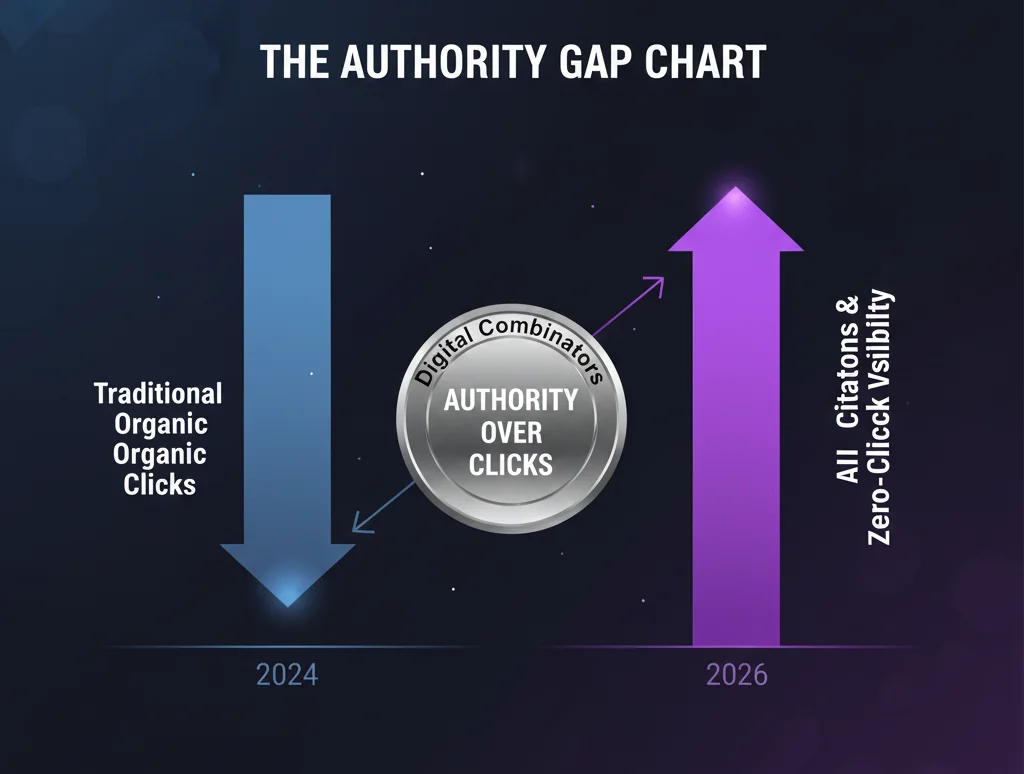
Let’s lead with a truth most agencies avoid: In 2026, a "click" is no longer the gold standard of success.
For years, we’ve been told that more traffic equals more growth. But in the era of Website Marketing Strategy 2026, that logic has officially broken. Today, 91% of professionals identify their website as their #1 marketing channel. However, its role has shifted from a simple "destination" to a complex Authority Hub.
The Rise of the Zero-Click Reality
You are likely losing traffic to the very platforms intended to send it to you. With the rise of Generative Engine Optimization (GEO), AI-driven search results now provide answers directly on the search page, bypassing the need for a click.
- The Data: While search engines drive 53.3% of all website traffic, a massive chunk of that is now "zero-click."
- The AI Shift: In 2025, zero-click searches accounted for nearly 60-65% of all queries in the U.S. as users get their answers from AI overviews without ever leaving the search engine [Source: Simplilearn].
Does this mean your website is dying? No. It means the traffic that does reach you is more critical than ever.
Vanity Metrics vs. High-Intent Visibility
If your current strategy focuses on casting a wide net, you are paying for digital window shoppers. In 2026, we prioritize targeted traffic—users who have moved past the "what is this?" stage and are deep into the "how do I solve this?" stage.
- The Old Way: Measuring success by unique visitors and page views.
- The Digital Combinator Way: Measuring High-Intent Visibility. This means appearing in the AI citations that users trust and ensuring that when a user does click, they arrive on an "evaluation page" designed to solve a specific, complex problem.
Why "Less" is Often "More"
The myth is that you need a million visitors to scale. The reality in 2026 is that a brand with 5,000 highly targeted visitors—who stay, engage, and convert—will out-scale a brand with 50,000 "accidental" visitors every single time.
We aren't just looking for clicks; we are looking for signals of intent. Patterns in how users scroll, return, and interact with your deeper resources show whether you are actually solving their pain points or just taking up space in their browser.
Ready to stop chasing vanity metrics and start building real authority? At Digital Combinators, we specialize in transforming websites into high-intent growth engines. We don't just help you rank; we help you own the answer.
Explore Our Authority-First SEO Services
Beyond SEO—Mastering Generative Engine Optimization (GEO)
If you’re still obsessing over "keyword density," you’re playing a game that ended in 2024.
While organic search still drives a massive 53.3% of all website traffic, the mechanics have changed. We are no longer just optimizing for a search engine; we are optimizing for a generative engine. This is Generative Engine Optimization (GEO), and it’s the secret to maintaining AI Search Visibility in 2026.
From Keywords to Topical Authority
In the old world, you’d rank for "B2B marketing strategy." In 2026, AI models like Gemini and ChatGPT look for topical authority. They don't just want to see the keyword; they want to see that your website understands the entire ecosystem surrounding it.
The Value Add: Instead of creating ten small posts around different keywords, create one "Power Pillar" that addresses the deep, conversational queries your audience is actually asking.
- The Strategy: Map your content to real buying intent. If a user asks an AI, "How do I scale my tech brand in a crowded market?" your site needs to be the one the AI summarizes and cites as the expert source.
Structuring for AI Citations
To win in the GEO era, your website needs to be "AI-readable" and "human-trustable" at the same time. This is where the human touch meets technical precision.
- Be the Direct Answer: Use clear, authoritative headers that directly answer complex questions. AI models prioritize content that provides immediate, high-value insights rather than burying the lead.
- Depth over Breadth: Don't just repeat what's already out there. Add unique data, personal experience, or a controversial "take" that only a human expert could provide. This builds the E-E-A-T (Experience, Expertise, Authoritativeness, and Trustworthiness) that both AI and humans crave.
The GEO Twist: Conversational Search
Search is becoming a conversation. People are no longer typing "best marketing agency"; they are asking, "Which agency specializes in high-growth B2B brands with a focus on AI integration?"
By focusing on these long-tail, intent-heavy phrases, you aren't just attracting "traffic"—you are attracting qualified visitors who are already in the middle of their evaluation process.
The Human Moat—Building E-E-A-T That AI Can’t Mimic
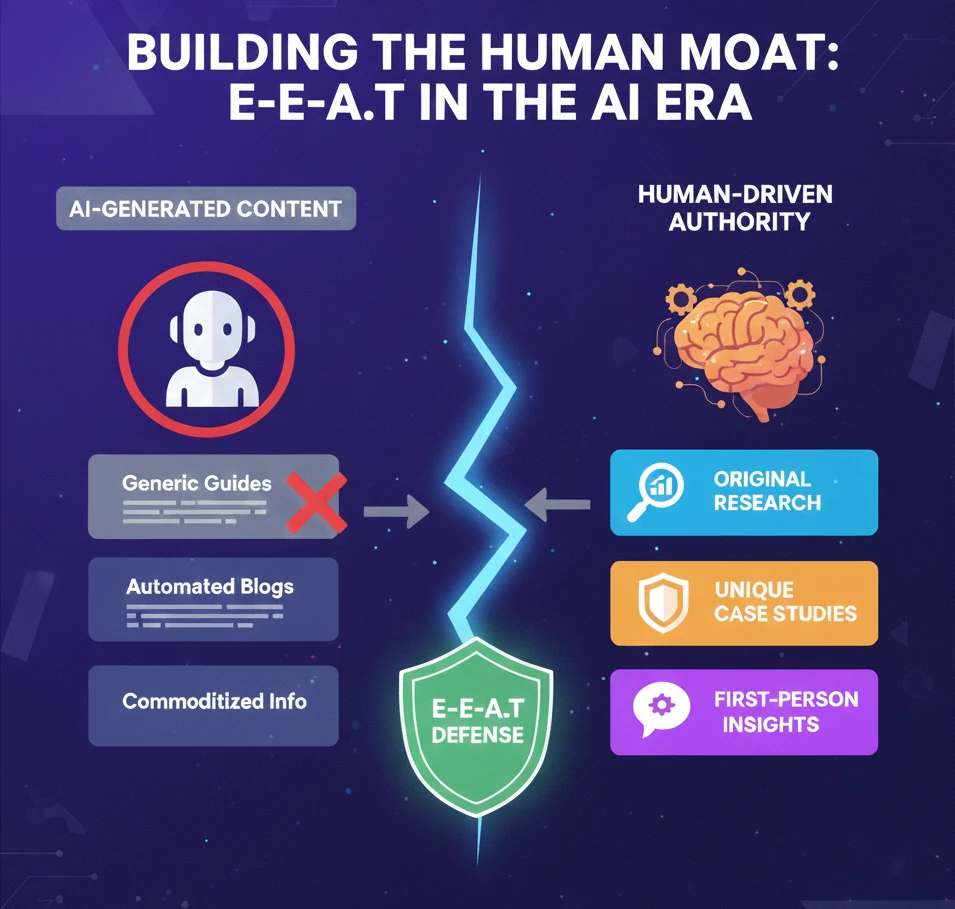
In 2026, "good" content is a commodity. AI can generate a thousand-word blog post in seconds, but it can't replicate experience.
While 83% of marketers still agree that content is the most effective way to generate demand, there is a massive problem: the web is being flooded with robotic fluff. To stand out, you need a "human moat."
The Authority Shift: E-E-A-T in 2026
Search engines and AI models are now hyper-focused on E-E-A-T (Experience, Expertise, Authoritativeness, and Trustworthiness). They are looking for signs that the person writing the content has actually lived the challenges they are describing.
- The Moat: Your website should prioritize original research, unique case studies, and first-person insights. This isn't just "content"; it's a defensive barrier that automated competitors simply cannot cross.
- The Human Touch: Instead of generic guides, share the "messy" details of a project—what failed, what was learned, and the specific human intuition that saved the day.
The Hidden Twist: Personalization via Perspective
We know that 88% of marketers see a direct link between personalization and sales. But in 2026, personalization isn't just about using a visitor's name—it's about providing a unique perspective that resonates with their specific industry struggles.
When your content reflects real-world market challenges and offers guidance that can be applied immediately, you stop being a "vendor" and become a "credible source" long before a prospect even reaches out.
The Strategy: Don't just answer the question; add the "human why" behind the answer. That is the only thing AI can't hallucinate or replicate.
The Non-Linear Funnel — Mapping Intent-Based Ecosystems
In the old days, we thought of the buyer journey as a straight line: they see an ad, they click, and they buy. In 2026, that straight line has turned into a web.
Today's website marketing strategy for 2026 must account for Non-linear buyer journeys. A prospect might find you through an AI citation, check your LinkedIn profile, listen to a podcast snippet, and then visit your website. This is why we focus on intent-based traffic acquisition rather than just chasing "clicks."
The Shift to "Evaluation Pages"
Standard service pages that just say "we do X" are no longer enough. Prospects use your site to decide if you truly understand their specific pain points.
- The Strategy: We move away from generic descriptions and toward evaluation pages. These are deep-dive resources—comparison guides, specialized landing pages, or technical breakdowns—that help a buyer narrow their shortlist.
- Map to Intent: Instead of broad topics, we identify phrases prospects use when they are actively evaluating solutions.
Guiding the "Messy Middle"
Buyers rely on your website more than most organizations assume, using those early moments to judge if you are connected to what matters to them.
- Segmented Journeys: Use automated sequences to guide prospects back to these key evaluation pages at the exact moments their interest peaks.
- The Hidden Twist: Your most valuable visitor isn't always the one who converts on visit number one. It’s the one who returns three or four times to engage with your deeper insights. Each return is a "signal of intent" that they are moving closer to a decision.
Discovery Engines—Bridging the Gap Between Social and Web
In 2026, social media isn't just for "likes"—it's a primary search engine.
Research shows that 37% of all consumers now use social media as their starting point for product research, a trend driven by a "social-first" mindset among 41% of Gen Z [Source: Sprout Social]. If your website is the "closing room," social platforms are your "discovery engines."
The Authority Filter: LinkedIn & Beyond
For B2B brands, LinkedIn has evolved into the ultimate credibility filter. With over 1 billion users in 2025 [Source: Sopro], it is where professionals go to verify that you actually know your stuff before they ever click "Visit Website."
- The Strategy: Use social to distribute the "Human Moat" content we built in Section 3. Share the snippets, the raw videos, and the controversial takes.
- The Goal: You aren't just looking for reach; you're looking for referral intent. When a user moves from a LinkedIn deep dive to your website, they aren't a "visitor"—they are a "prospect" who has already passed a trust check.
Driving to High-Value "Bridge" Pages
The biggest mistake in 2026 is driving social traffic to your homepage. It’s too broad.
- The Bridge: Link social posts directly to the Evaluation Pages we discussed in Section 4. If you're talking about AI integration on social, the link should lead to a technical breakdown or a case study on your site—not a generic "About Us" page.
- The Twist: Social is where you build the relationship; the website is where you provide the resolution.
According to recent data, 58% of consumers now discover new businesses via social media, outperforming traditional search and even TV [Source: Sprinklr]. By treating social as a discovery engine rather than a megaphone, you ensure the traffic reaching your site is pre-qualified and ready to engage.
The Personalization Paradox—Crafting "Segments of One"
In 2026, we face a contradiction: users are more protective of their privacy than ever, yet they demand experiences that feel specifically built for them. This is the personalization paradox.
According to research by McKinsey, 71% of consumers now expect companies to deliver personalized interactions, and 76% get frustrated when this doesn’t happen [Source: McKinsey & Company]. To succeed in your Website Marketing Strategy 2026, you must move beyond generic "Hi [First Name]" emails and toward the "Segment of One."
Moving to Behavioral Conversion Refinement
The "Segment of One" means your website adapts in real-time to an individual’s current intent, not just their demographic. This is called behavioral conversion refinement.
- The Strategy: Instead of showing the same homepage to everyone, use AI-driven triggers to swap content blocks based on the visitor's entry point. If a user arrives from a technical LinkedIn post, your site should prioritize deep-dive whitepapers over high-level overview videos.
- The ROI: Companies that excel at this level of personalization generate 40% more revenue from these activities than their slower-growing competitors [Source: McKinsey].
The Hidden Twist: Permission-Based Personalization
The "creepy" factor is real. In 2026, the most effective targeted traffic strategies rely on first-party data—information the user willingly gives you in exchange for value.
- The Human Touch: Use "Micro-Conversions"—like a quick 3-question quiz or a "Choose Your Journey" button—to let users self-segment. This respects their privacy while giving you the data needed to hyper-personalize their experience.
By focusing on helping the user rather than just "tracking" them, you turn a potential privacy concern into a high-trust relationship. When a call-to-action (CTA) is personalized to a user's specific stage in the funnel, it can perform 202% better than a generic one [Source: HubSpot].
Multimodal Authority—Why Text is No Longer Enough
By 2026, the way we consume information has fundamentally shifted. We no longer just "read" the web; we watch, listen, and interact with it.
According to research, viewers retain 95% of a message when they watch it in a video, compared to just 10% when reading it in text [Source: Synthesia]. To build true authority in 2026, your website must be multimodal.
The Power of Video and "Human Presence"
In an era of AI-generated text, video is the ultimate proof of life. It builds trust at a speed text cannot match because it captures nuance, tone, and personality.
- The ROI: Adding video to a landing page can increase conversion rates by up to 80% [Source: Firework].
- Dwell Time: Websites with video content are 53 times more likely to rank on the first page of Google because search engines prioritize "dwell time"—the amount of time a user stays on your page [Source: The Breezy Company].
Interactive Content: From Passive to Active
The 2026 buyer is suffering from "scroll fatigue." They don't want to be talked at; they want to participate.
- The Strategy: Use interactive tools like calculators, assessments, or "choose-your-own-adventure" infographics.
- The Impact: Interactive content generates 2x more conversions than passive content [Source: DemandGen]. It transforms a visitor from a spectator into an active participant in your brand's ecosystem.
Multimodal SEO: Optimizing for All Senses
Multimodal search means users are now searching with images (Google Lens), voice (Gemini/Siri), and video snippets.
- The Human Touch: Don't just post a video; provide a transcript for the readers, an audio version for the commuters, and a summary for the skimmers. This "format flexibility" ensures you meet your audience wherever they are, in whatever way they prefer to learn.
Behavioral Intelligence—Listening to the Unspoken Data
The final layer of a 2026 strategy isn't about what users say; it’s about what they do. In a world of increasing privacy, behavioral intelligence allows you to optimize your site using first-party data—data you own and that users have consented to share through their actions.
From "Page Views" to "Signals of Intent"
In 2026, we stop chasing vanity metrics and start tracking Signals of Intent.
- The Insight: A user who visits your pricing page three times in 48 hours is a high-intent signal. A user who "rage-clicks" a broken link or spends five minutes on a technical case study is telling you exactly where they are in their journey [Source: Artisan AI].
- The Strategy: Use heatmaps and session recordings to identify "friction points." If users are dropping off halfway through a long-form blog, it’s a signal to move your high-value insights or CTAs further up the page [Source: Hav Strategy].
The ROI of Behavioral Refinement
Websites that use behavioral data to refine their user experience see a significant boost in performance.
- Conversion Impact: Companies integrating AI to interpret behavioral signals—like scroll depth and navigation patterns—can see conversion rates increase by 20-30% [Source: ResultFirst].
- The Human Touch: This isn't about "tracking" people; it's about "listening" to them. When you fix a page because the data shows users are confused, you are providing a better service.
Ready to Lead the 2026 Digital Shift?
We’ve covered the 8 pillars of a modern, depth-heavy website strategy—from mastering GEO to building a "Human Moat." But strategy is only as good as its execution.
At Digital Combinators, we don't just build websites; we build Authority Engines. We combine the precision of AI-driven data with a human-first philosophy to ensure your brand doesn't just get "clicks" but owns the answer in your industry.
If you’re ready to move past the traditional checklist and start building for the future, we invite you to connect with us. Let’s turn your website into your most powerful growth asset.